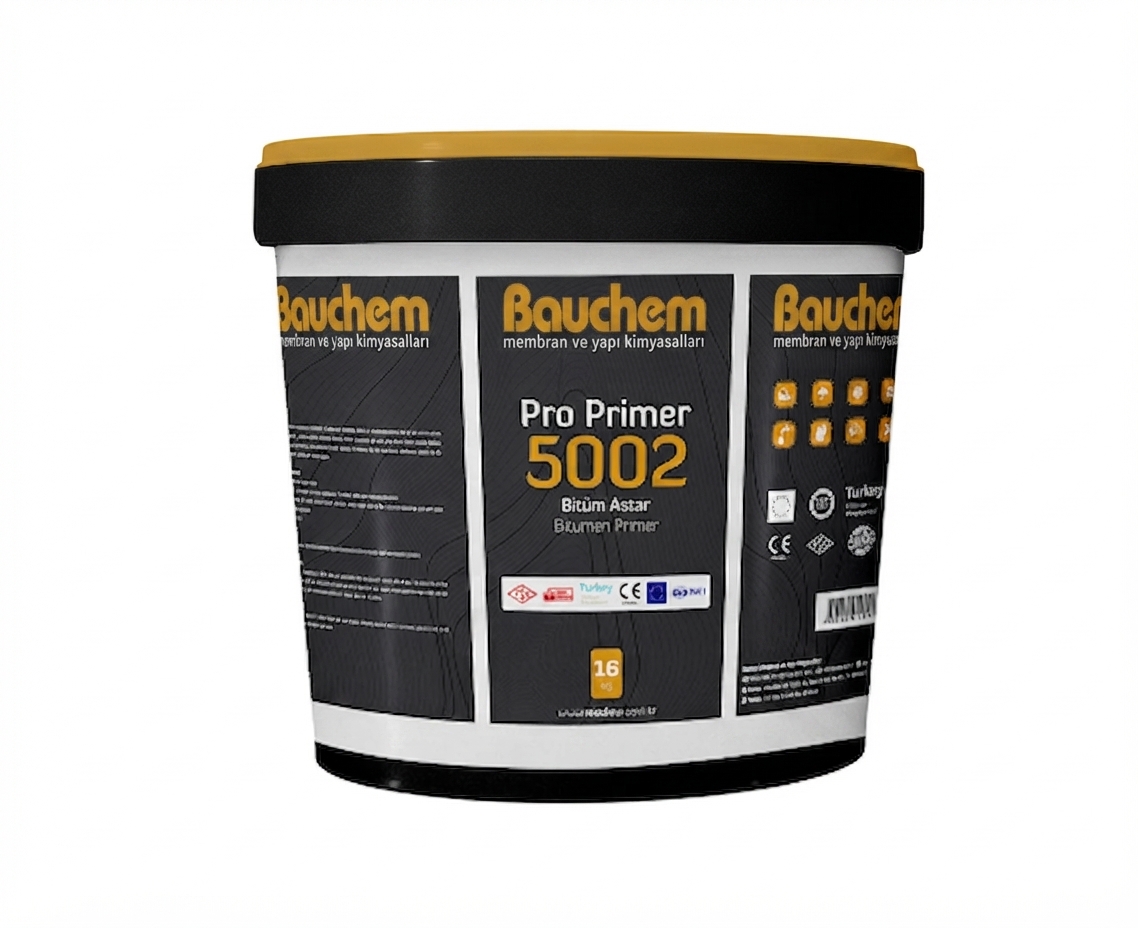
Pro Primer 5002

Pro Primer 5002 Surface Preparation and Application Guide

Surface Preparation

  • Clean the surface to be applied free of dust, dirt, rust, and oil, and scrape off loose parts.

  • Round off areas prone to cracking, such as horizontal/vertical joint lines, using ProEdit 5045 repair mortar or chamfer tape.

  • Fill large pores and cracks with ProEdit 5045 repair mortar.

Application

  • ProPrimer 5002 is applied cold.

  • After mixing with approximately %20 water, it is applied with a bitumen brush or spray gun.

  • It dries in about 4-5 hours depending on weather conditions.

  • It should not be applied in rainy weather or at temperatures below $-5\text{ }^\circ\text{C}$.

  • The next coat should not be applied before the previous one is completely dry.

  • On cracked surfaces or in insulation applications requiring resistance to higher pressure water, it can be used together with reinforcement such as reinforcing mesh, polyester felt, or insulation fabric.

  • A screed material obtained by mixing ProPrimer 5002 with sifted fine sand and a small amount of cement can be applied with a trowel to level pit sections on the ground or to create a protective layer over insulation layers.

  • It is a ready-to-use bituminous membrane primer and waterproofing material obtained by mixing water and bitumen using special methods.

Advantageous Features

  • Thanks to its superior adhesion property, it ensures that bitumen-based products applied on top adhere to the surface more securely and without gaps.

  • After the water in its structure evaporates, it forms a waterproof layer on the surface it is applied to.

  • Since it does not contain flammable and toxic substances, it is suitable for use in enclosed areas.

  • It is environmentally friendly because it is water-based.

  • It provides excellent adhesion even if the surface is damp.

Areas of Use

  • Used as a primer before the application of all brands of roll and liquid bitumen-based membranes.

  • Used on all horizontal and vertical surfaces.

  • Used in positive-side (external) insulation of foundations, cellars, and basements.

  • Used in the insulation of enclosed wet spaces such as bathrooms, kitchens, and toilets.

  • Used as a primer on screed in parquet bonding applications with hot bitumen.

  • Used by applying to construction molds to ensure easy removal of molds and to obtain a smooth surface.