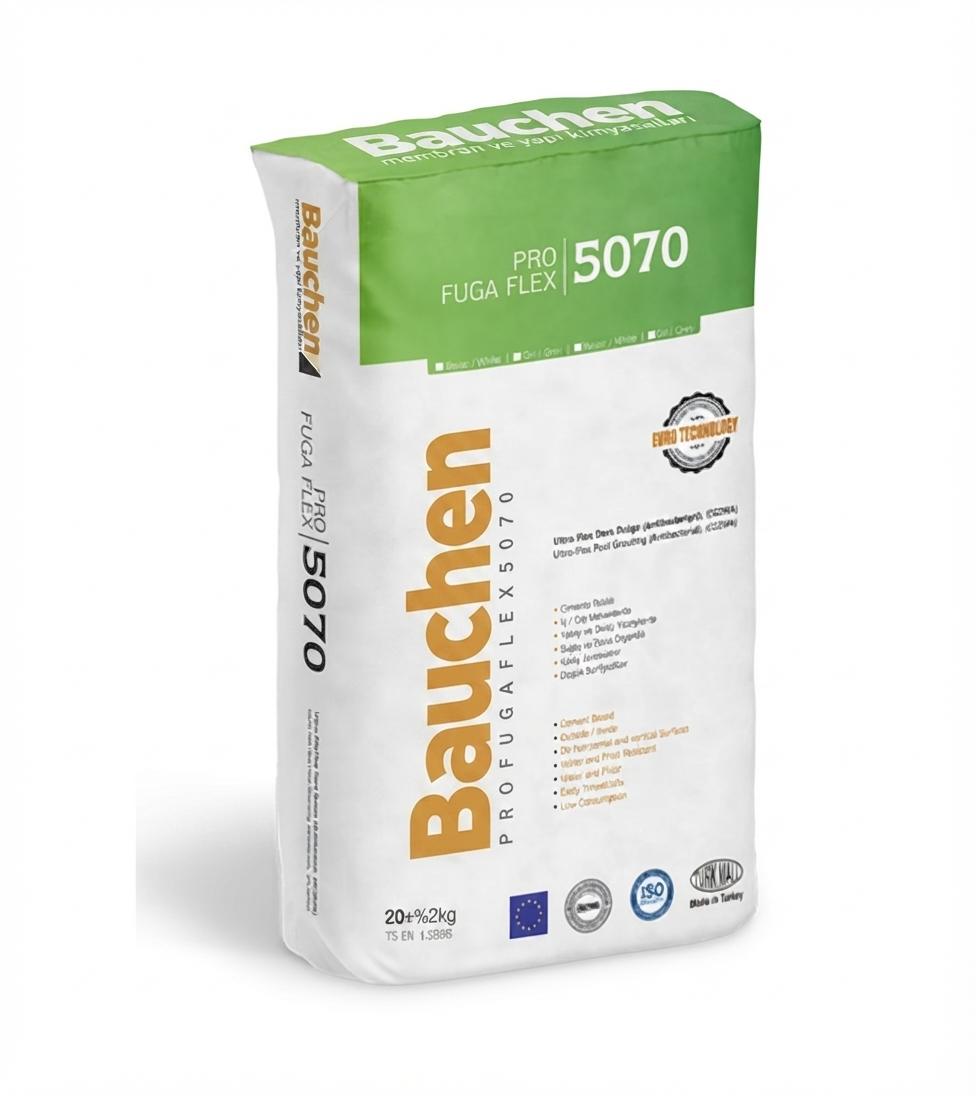
Profuga Flex 5070

Profuga Flex 5070 Surface Preparation and Application Guide

Surface Preparation

  • Ensure that the ceramics are well-adhered so they do not move during application, and make sure the adhesive is fully dry.

  • Thoroughly clean any dust, dirt, sawdust, construction, and cement residues remaining inside the joint gaps using a thin stick or brush.

  • Ensure that the joint gaps are at least $2/3$ of the ceramic thickness.

  • Moisten the cleaned gaps with the help of a wet sponge.

Application

  • Fill the joints using a squeegee with a hard rubber tip or a joint spreading trowel with a hard rubber base.

  • Apply the material first parallel and then crosswise to fill the gaps thoroughly.

  • Scrape off the excess mortar on the surface using a dampened soft-tipped spatula, wait $15-30$ minutes depending on the ambient temperature, and then wipe with a damp sponge to thoroughly clean any thin joint film remaining on the surface.

  • Do not start the joint wiping process prematurely.

  • Avoid wiping with an excessively wet sponge to prevent color fluctuations.

  • Clean the sponge being used at frequent intervals.

  • Walls dry after 12 hours, floors can be walked on after 24 hours, and pedestrian traffic can open after 7 days.

  • It is a high-performance, highly flexible cement-based joint filler material suitable for $1 – 6\text{ mm}$ joint gaps and usable in indoor and outdoor spaces.

Advantageous Features

  • It does not fade, powder, or crack.

  • It provides a smooth surface.

  • It is not affected by sudden temperature changes.

  • It is resistant to water and frost.

  • It can be used in underfloor heating systems.

  • It adheres perfectly to ceramic edges without cracking.

  • It offers a rich color selection and is decorative.

  • It is resistant to abrasion.

Areas of Use

  • Used in indoor and outdoor spaces.

  • Used in horizontal and vertical applications.

  • Used in locations such as swimming pools, water tanks, Turkish baths, and saunas.

  • Used in underfloor heating systems and heavy industrial chemical areas.

  • Used for filling joints up to $1 – 6\text{ mm}$ for coverings like granite ceramic, large-sized ceramic, tiles, natural granite, marble, klinker, and glass mosaic.