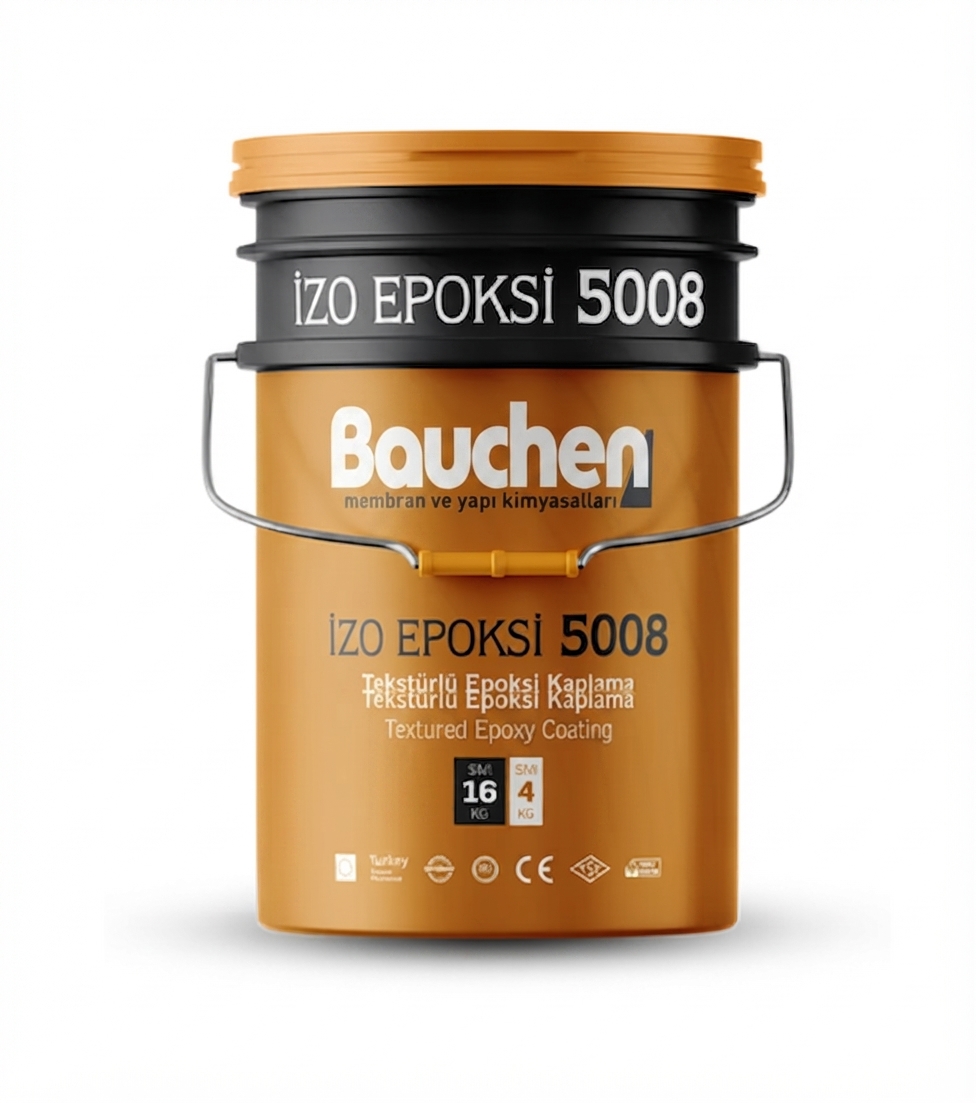
Swimming Pool and Wet Area Systemsİzo Epoksi 5008
İzo Epoksi 5008 Surface Preparation, Application, and Rules Guide
Surface Preparation
-
Ensure the surface is dry, sound, and has sufficient compressive strength ($\min. 25\text{ N/mm}^2$).
-
The pull-off adhesion strength of the surface must be at least $1.5\text{ N/mm}^2$.
-
The surface must be clean and free from residues that would prevent adhesion, such as dust, dirt, oil, coatings, and surface curing materials.
-
Concrete surfaces should be abraded using abrasive equipment suitable for surface characteristics to obtain a pored surface, removing the cement slurry to reach the aggregate.
-
The concrete surface to be applied should be cleaned with the help of a water jet.
-
The moisture content in the surface should not exceed %4 by weight, and there should be no rising moisture from the surface (performing a PE sheet test is recommended for control).
-
Ensure that the floor temperature remains constant between min. $+10\text{ }^\circ\text{C}$ and max. $+30\text{ }^\circ\text{C}$ and is at least $+3\text{ }^\circ\text{C}$ above the dew point.
-
Before application, check the suitability of conditions for surface moisture, relative humidity, temperature, and dew point.
Application
-
İZO EPOKSI 5008 comes in ready sets according to the mixing ratio, ensuring the product to be mixed is between $+15\text{ }^\circ\text{C}$ and $+25\text{ }^\circ\text{C}$.
-
Component A should be stirred in its own container before Component B is added.
-
The entire Component B must be added to Component A, ensuring no material is left in Component B’s container.
-
An electric mixer at low speed (300-400 rpm) should be used for mixing, stirring continuously for approximately 3 minutes until a homogeneous mixture is achieved.
-
After letting the mixture rest, it should be remixed for 2 minutes, avoiding excessive mixing to prevent air entrapment.
-
Depending on the surface, silica sand ($0.1-0.3\text{ mm}$) can be added at a ratio of 1:0.50 to 1:2 by weight to thicken the material for priming.
-
The ambient temperature during application must be in the $+15\text{ }^\circ\text{C}$ to $+25\text{ }^\circ\text{C}$ range.
-
High temperatures can decrease drying/curing times, viscosity, and associated consumption, while low temperatures can increase these durations.
-
It can be applied by spreading with a brush, rollable application, or a flat trowel onto the surface.
-
Ensure that a continuous and non-porous layer covers the surface.
-
If the primer is to be covered with an epoxy or polyurethane-based material, silica sand with a fraction of $0.3\text{ mm}$ to $1.0\text{ mm}$ should be broadcast onto the primer while it is still wet at a consumption rate of $1\text{ kg/m}^2$.
-
The waiting time for applying subsequent layers should not exceed 48 hours; if exceeded, abrading and applying a fresh primer or scratch coat is recommended.
Rules
-
Avoid application at temperatures below $-5\text{ }^\circ\text{C}$ and above $+35\text{ }^\circ\text{C}$.
-
Avoid application on frozen surfaces, surfaces with a risk of freezing within 24 hours, or in areas directly exposed to sunlight and wind.
-
Do not add external water to the mixture.
-
The powder component must always be added to the liquid component.
-
During application, the wet film thickness for a single layer must not exceed $2\text{ mm}$.